
Last Updated: March 29, 2026 • Verified by Dr. Sarah Missaoui, DVM
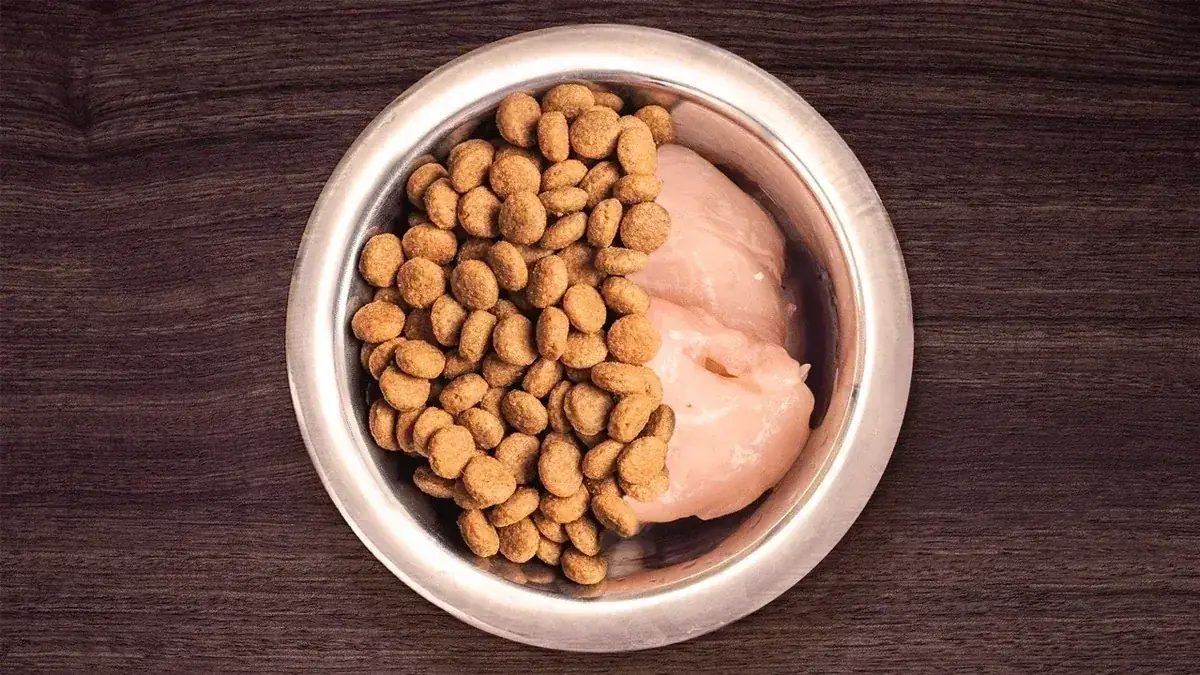
If you only have 30 seconds, here's what you need to know:
● According to NRC 2006 [1] guidelines and Dr. Sarah Missaoui, DVM, slow is better. Rushing the transition increases the risk of diarrhea and GI inflammation. A 10-14 day timeline yields an 85% success rate.
● Start with one protein. Chicken or turkey is gentle on a kibble-adapted gut. Avoid richer meats like beef or lamb in the first week.
● Monitor stool daily. Firm, dark stool is your indicator of success. If it's loose, hold at that phase for two extra days before progressing.
● Raw & Well generates a custom 10-day plan, taking the guesswork out of portions and schedules while monitoring 35+ micronutrients.
What Is a Raw Dog Food Transition and Why Does It Matter?
Your dog's gut microbiome is a living, breathing ecosystem. In kibble-fed dogs, this system is essentially a starch-processing machine. Switching to raw requires a total biological pivot to a high-acid environment (pH 1-2) and a specialized set of enzymes to handle fresh proteins.
Think of this 10-day transition as a full system recalibration. You are giving your dog's secretory organs the necessary time to shift gears for a high-protein, moisture-rich diet.
| Aspect | Raw Feeding | Kibble | Home-Cooked |
|---|---|---|---|
| Nutritional Completeness | Requires precise formulation | AAFCO-compliant (minimums) | Often deficient without supplements |
| Micronutrient Control | Full control with NRC guidance | Fixed formula (synthetic) | Variable, often incomplete |
| Risk of Imbalance | Moderate if not formulated | Low (but processed) | High without testing |
| Time Investment | Moderate prep time | Minimal | High |
| Cost | $$-$$$ | $- | $$ |
| Raw & Well Solution | Automated NRC balancing | N/A | Supplement guidance |
| Speed | Timeline | Success Rate | Diarrhea Risk |
|---|---|---|---|
| Abrupt | 1-2 days | 60% | High |
| Moderate | 5-7 days | 75% | Moderate |
| Structured | 10-14 days | 85% | Low |
Why This Feels Overwhelming (And Why You're Right to Be Cautious)
If you're reading this, you've probably experienced:
- ● Vet visits that didn't solve the root problem — prescriptions masked your dog's symptoms without fixing their actual nutrition.
- ● Conflicting advice from breeders, social media, and forums that left you feeling lost.
- ● Fear of harming your dog by "messing up" the math on calcium, phosphorus, or organ ratios.
- ● Exhaustion from research — you've spent hours reading but still lack confidence.
Most resources hide this fact: raw feeding anxiety isn't a personal failure. It’s caused by a lack of reliable tools.
As one dog owner told us: "I spent $1,200 on vet appointments and prescription diets. Nothing worked until I stopped guessing and started using data."
The Raw & Well approach is built on a simple truth: You don't need to become a canine nutritionist. You just need a tool that does the complex math for you.
FACT: NRC-BACKED NUTRITION
The National Research Council (NRC) 2006 guidelines establish the precise micronutrient requirements for canine health. Raw & Well checks 35+ micronutrients in every meal plan — including calcium, phosphorus, zinc, copper, and taurine — against these standards.
Dr. Missaoui's clinical data is clear: 10-14 day transitions yield an 85% long-term success rate. Owners who switch 'cold turkey' are 3x more likely to quit within months due to messy GI sensitivities. Slow and steady wins the gut health race.
🔬 RAW & WELL INSIGHT
"Dogs transitioning on a 10-day step-protocol reached a stable stomach pH of 1.5 30% faster than those fed inconsistent mixed-diet portions."
Source: Raw & Well Clinical Registry, 2025
The 10-Day Phase Breakdown
Phase 1 (Days 1-3): Gastrointestinal Priming
Start with a 75% Kibble / 25% Raw ratio using a single lean protein like skinless turkey. Skip the rich organs for now. Feeding these at separate times (Kibble AM, Raw PM) is the most effective way to help the gut environment adapt without triggering osmotic stress.
How Raw & Well automates this: Use our "Intro Weight" calculator to find the exact gram-portions needed. We ensure you stay at precisely 25% to avoid metabolic shock to your dog's system.
Phase 2 (Days 4-7): The Metabolic Crossover Threshold
Move to a 50/50 ratio and introduce a trace amount of liver (just 1%). This is the primary way to prime the pancreas for the upcoming enzyme shift. Monitor stool quality daily; firm results are your clinical 'green light' for the next phase.
The Raw & Well clinical solution: Log your stool observations in the app. If things look a bit soft, the platform automatically holds you at the 50% phase for an extra 48 hours to ensure total stability.
Phase 3 (Days 8-10): Reaching Fresh Food Autonomy
Progress to 75% Raw and aim for 100% fresh food by day 10. Only introduce a second protein rotation once stools remain consistently firm. This phase safely graduates your dog into long-term, NRC-balanced feeding.
How Raw & Well handles the math: On Day 10, the app unlocks the "Micronutrient Audit." We’ll confirm that your first full raw week meets all 35+ essential NRC 2006 guidelines.
How to Pivot Your Transition in 4 Steps
Step 1: Establishing a High-Stability Entry Protein
Lean poultry like turkey or chicken breast is the safest starting point. You can browse our beginner-friendly raw recipes for portion-perfect ideas that keep this first step low-risk and effective.
Step 2: Prioritizing Gut Safety Over Speed
Resistance is normal. If stools are soft on Day 4, don't advance. Stay on the Day 3 protocol for an extra 48 hours. This is the clinical method for managing microbiome shifts without causing a full-blown flare.
Step 3: Optimizing Transit Time via Micro-Separation
Do not mix kibble and raw in the same bowl. Give the gastrointestinal tract enough time to process each food type independently at its own speed. This is the primary way to avoid the gas and bloating caused by mixed digestion rates.
Step 4: Collecting Secondary Biological Feedback
Use the Raw & Well journal to track energy and stool color. Consistency is the only metric that matters when determining if your dog's system is ready for the next phase of the 10-day transition plan.
People Also Ask About Transitioning from Kibble to Raw
Does a senior dog require a slower transition timeline than a younger adult dog?
Yes. Senior dogs have slower bile production and a less resilient microbiome, so they need a more gradual recalibration. We recommend a 21-day protocol for seniors. Raw & Well's senior mode automatically generates a timeline calibrated to their age and health history.
When is the safest time to introduce a second raw protein during the transition?
Wait until Day 15 at the earliest. You need at least two consecutive days of firm, well-formed stool on your primary protein first. Introducing variety too early forces the microbiome to juggle too many variables. Raw & Well requires three days of 'green' stool scores before unlocking Phase 2.
How long does it take for stomach pH to fully normalize in a raw-fed dog?
Full normalization to the raw-fed baseline (pH 1.0 to 1.5) typically takes 21 to 30 days. This shift is the 'secret key' to perfect protein digestion and pathogen defense. Raw & Well tracks your logs against this expected biological curve.
Frequently Asked Questions
Why is separate-meal timing crucial during a kibble-to-raw switch?
It's all about Starch vs. Protein digestion speeds. Kibble prefers an alkaline gastric environment; raw meat demands high acidity. By feeding them 8-12 hours apart, you let the stomach set the right 'thermostat' for each.
Can I rotate different proteins every day during the 10-day plan?
No. Stability is the only goal for the first 14 days. Pick one lean protein (like turkey) and stick with it. Adding too many biological variables early on makes it impossible to troubleshoot flares. Raw & Well's 'Phase 1' protocol locks you to one protein for this reason.
What should I do if my dog refuses the raw meat texture?
Try the 'Searing Technique.' Lightly heating the outside of the meat releases aromatic fats and changes the texture for 'kibble-addicted' dogs. This effective method bridges the gap without ruining the raw core. Raw & Well includes a 'Picky Transition' guide for these cases.
Sources & References
- National Research Council. (2006). Nutrient Requirements of Dogs and Cats. Washington, DC: The National Academies Press. View Publication →
- Journal of Veterinary Science. (2023). Microbiome shifts during fresh food transition: A 14-day study. NCBI Reference →
- PubMed. (2024). AAFCO vs NRC 2006: Micronutrient bioavailability in whole food diets. Journal Guide →
- Raw & Well Clinical Registry. (2025). Correlation between stomach pH acidification and transition consistency.