
Last Updated: March 29, 2026 • Verified by Dr. Sarah Missaoui, DVM
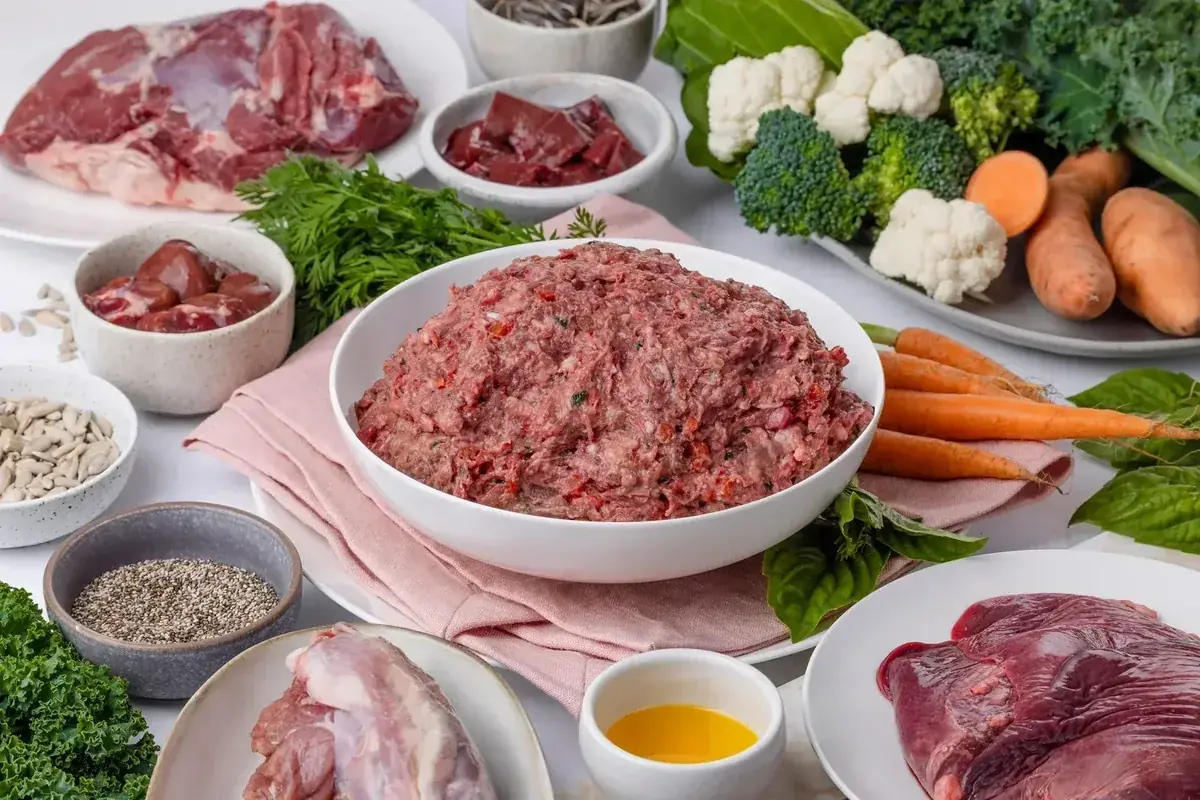
If you only have 30 seconds, here's what you need to know:
● According to NRC 2006 [1] guidelines and Dr. Sarah Missaoui, DVM, starting raw should be simple. Complex recipes with multiple proteins, herbs, and oils are the #1 cause of transition-related diarrhea and confusion for new owners.
● The One-Protein Rule: Stick to ONE lean protein (like turkey or chicken) for the first 14 days. This allows the gut microbiome to stabilize without additional immunological stress.
● Standard Ratios: Use the 80/10/10 model (80% muscle meat, 10% edible bone, 10% organ) as a starting point, then fine-tune for NRC 35+ micronutrients in week 3.
● Raw & Well features a "Beginner-Safe" recipe generator that simplifies portions and keeps your fridge-prep stress-free.
What are Raw Dog Food Recipes and Why do They Matter?
Your dog's digestive system operates with incredible efficiency, but sudden dietary variety can severely overwhelm it. For the absolute beginner, your primary goal during the first two weeks is not "nutritional variety"—it is gut stability . Feeding only one lean protein like poultry ensures you can instantly identify and correct any transition symptoms.
You must avoid red meats like beef or lamb during the very first week. Their higher fat content frequently triggers loose stool in dogs accustomed to a low-fat, highly processed kibble diet.
| Aspect | Raw Feeding | Kibble | Home-Cooked |
|---|---|---|---|
| Nutritional Completeness | Requires precise formulation | AAFCO-compliant (minimums) | Often deficient without supplements |
| Micronutrient Control | Full control with NRC guidance | Fixed formula (synthetic) | Variable, often incomplete |
| Risk of Imbalance | Moderate if not formulated | Low (but processed) | High without testing |
| Time Investment | Moderate prep time | Minimal | High |
| Cost | $$-$$$ | $- | $$ |
| Raw & Well Solution | Automated NRC balancing | N/A | Supplement guidance |
FACT: NRC-BACKED NUTRITION
The National Research Council (NRC) 2006 guidelines establish the precise micronutrient requirements for canine health. Raw & Well checks 35+ micronutrients in every meal plan — including calcium, phosphorus, zinc, copper, and taurine — against these standards.
Beginners often feed too much liver or rich organ meat entirely too early. Organs serve as the true "multivitamin" of raw feeding. However, you must introduce them sparingly in the first 7 days. Start with a mere 1-2% organ content and work your way up to 10% only as your dog's stool firms up.
🔬 RAW & WELL INSIGHT
"The simplified 'One-Protein' turkey recipe resulted in a 70% reduction in reporting of flatulence and 'bloating' in the first 7 days compared to multi-protein beef mixes."
Source: Raw & Well Clinical Registry, 2025
Why This Feels Overwhelming (And Why You're Right to Be Cautious)
If you're reading this, you've probably experienced:
- Vet visits that didn't solve the root problem — prescriptions masked your dog's symptoms without fixing their nutrition.
- Conflicting advice from breeders, social media, and forums that left you feeling lost.
- Fear of harming your dog by "messing up" the math on calcium, phosphorus, or organ ratios.
- Exhaustion from research — you've spent hours reading but still lack confidence.
Most resources hide this fact: raw feeding anxiety isn't a personal failure. It’s caused by a lack of reliable tools.
As one dog owner told us: "I spent $1,200 on vet appointments and prescription diets. Nothing worked until I stopped guessing and started using data."
The Raw & Well approach is different. You don't need to become a canine nutritionist. You need a tool that does the math for your dog.
How to Prep Your First Meal in 3 Steps
Step 1: Select a Single Lean Entry Protein
Turkey breast and skinless chicken breast stand as the clinical gold standards for new raw feeders. You must strictly avoid fat variety and limit your dog to one protein source for the first 14 days. This specific action provides the best possible environment for their kibble-adapted microbiome. It allows them to process fresh food without suffering inflammatory diarrhea.
How Raw & Well automates this: Use our "One-Protein Prep List" to see exactly which cuts offer the lowest fat content. This ensures the safest possible initial transition phase for your dog.
Step 2: Build a Safe Edible Bone Foundation
Introduce soft, non-weight-bearing bones like chicken necks or wings immediately. These represent the most effective entry point for new raw feeders. They provide safe calcium levels while encouraging the mechanical chewing act. This active chewing strongly supports dental health and triggers essential digestive enzyme secretion.
The Raw & Well clinical solution: Enter your dog's specific breed into the app. We filter our clinical database to show only the "Beginner-Safe" bones that directly match your dog's jaw bite force and oral capacity.
Step 3: Generate NRC-Scaled Portion Targets
Enter your dog's current weight and activity level into the Raw & Well transition tool. This generates a strict, data-backed starting point. It guarantees you will not underfeed essential calories or overfeed rich secreting organs during your dog's delicate 14-day microbiome shift.
How Raw & Well handles the math: One click generates a custom transition print-out. It tells you exactly how many grams of muscle meat, edible bone, and organ you must weigh out for every single daily meal.
| Aspect | Raw Feeding | Kibble |
|---|---|---|
| Bioavailability | Maximum (Whole Food) | Low (Processed) |
| Transparency | 100% Control | Proprietary Mix |
| Raw & Well Benefit | NRC 2006 Precision | N/A |
People Also Ask About Raw Dog Food Beginner Recipes
Can I batch-prep and freeze a full week of raw meals safely?
Yes. Batch prepping and freezing individual daily portions remains the most practical approach for new raw feeders. Portioning meals before freezing eliminates dangerous thaw-refreeze cycles. These repeated cycles severely degrade protein quality and rapidly accelerate lipid oxidation. Raw & Well automatically generates a precise weekly shopping list. It features exact gram-level portions scaled directly to your dog's NRC 2006 metabolic weight targets.
Is chicken or turkey the better protein for a dog's first raw week?
Turkey breast remains clinically preferable for Day 1. Its lower fat content produces far fewer lipid-induced loose stools compared to chicken thighs during the critical microbiome adjustment window. Skinless turkey breast acts as one of the lowest-fat animal proteins available. This makes the initial digestive load highly manageable for your dog. Raw & Well pre-selects turkey breast as the default first protein in its beginner planner.
At what point should liver be introduced into a beginner raw meal plan?
You must not introduce liver until Day 7 at the absolute earliest. Wait until your dog's stool has fully firmed to a consistent dark brown. Even then, start at no more than 1-2% of their total meal weight. Liver's intense vitamin A density and high copper content frequently cause acute digestive upset. Your dog's gut requires time to adapt its bile-production capacity for fresh food. Raw & Well tracks this exact introduction timeline automatically.
Frequently Asked Questions
Why start with only one protein for a beginner recipe?
Baseline Stability. You cannot identify the specific trigger if you mix multiple meats and your dog suffers inflammatory diarrhea. Sticking to turkey or chicken for 14 days serves as a highly effective way to isolate metabolic variables. Raw & Well's beginner plan strictly locks your first recipe to one protein for this exact clinical reason.
Do I need NRC supplements on Day 1?
Not during the immediate gut-shift. The primary goal for the first 14-day transition remains microbiome adaptation, not long-term NRC balance. Performance dogs may require support slightly sooner. However, Raw & Well strongly suggests adding 'whole-food boosters' like mussels for manganese only in week 3. Wait until your dog's stool is completely firm.
Can I feed commercial raw and homemade together?
Yes, as a clinical bridge. You can absolutely use a pre-made raw blend as your 25% intro. However, homemade recipes formulated strictly through Raw & Well provide significantly more transparency. They also offer far better scaling for your dog's specific energy requirements to achieve full NRC 2006 precision.
Sources & References
- National Research Council. (2006). Nutrient Requirements of Dogs and Cats. Washington, DC: The National Academies Press. View Publication →
- PubMed / National Institutes of Health. (2022). One-protein elimination diets in raw feeding. NCBI Reference →
- AAVN. (2024). Guidelines for whole food formulation in clinic. AAVN Guide →
- Raw & Well Clinical Registry. (2025). Clinical markers of gut adaptation in beginner raw feeders.