
Last Updated: March 29, 2026 • Verified by Dr. Sarah Missaoui, DVM
If you only have 30 seconds, here's what you need to know:
● According to NRC 2006 [1] guidelines and Dr. Sarah Missaoui, DVM, the first 10-14 days are the highest risk period. Diarrhea is common but manageable with a structured protocol.
● IBD dogs need extra clinical precision. Raw feeding works when formulated with NRC 2006 standards for digestibility and low inflammation.
● 80% of transition problems trace to: speed, too much organ meat, or incorrect calcium:phosphorus ratios.
● Raw & Well provides day-by-day guidance and monitors 35+ micronutrients to ensure a successful, flare-free switch.
What Is Raw Feeding Transition and Why Does It Matter?
Think of the raw transition as a 10-day metabolic software update for your dog. You are moving them from high-starch, shelf-stable kibble to living, enzyme-rich whole proteins. This 10-day crossover period is the primary way to avoid the "detox" symptoms of a cold-turkey switch by giving the digestive system time to recalibrate.
If your dog has IBD (Inflammatory Bowel Disease), the stakes are higher and the gut is more sensitive. They require a staged, clinical introduction to avoid painful flares. For these compromised guts, a 21-day transition serves as the safest and most effective protocol.
| Aspect | Raw Feeding | Kibble | Home-Cooked |
|---|---|---|---|
| Nutritional Completeness | Requires precise formulation | AAFCO-compliant (minimums) | Often deficient without supplements |
| Micronutrient Control | Full control with NRC guidance | Fixed formula (synthetic) | Variable, often incomplete |
| Risk of Imbalance | Moderate if not formulated | Low (but processed) | High without testing |
| Time Investment | Moderate prep time | Minimal | High |
| Cost | $$-$$$ | $- | $$ |
| Raw & Well Solution | Automated NRC balancing | N/A | Supplement guidance |
| Aspect | Slow Transition (10-14 days) | IBD Protocol (14-21 days) |
|---|---|---|
| Success Rate | High (85%) | Very High (90%+) |
| Diarrhea Risk | Moderate | Low with monitoring |
| Nutritional Precision | Moderate | High with NRC checking |
| Raw & Well Solution | Day-by-day guidance | IBD-specific protocol |
Why This Feels Overwhelming (And Why You're Right to Be Cautious)
If you're reading this, you've probably experienced:
- ● Vet visits that didn't solve the root problem — prescriptions masked your dog's symptoms without fixing their actual nutrition.
- ● Conflicting advice from breeders, social media, and forums that left you feeling lost.
- ● Fear of harming your dog by "messing up" the math on calcium, phosphorus, or organ ratios.
- ● Exhaustion from research — you've spent hours reading but still lack confidence.
Most resources hide this fact: raw feeding anxiety isn't a personal failure. It’s caused by a lack of reliable tools.
As one dog owner told us: "I spent $1,200 on vet appointments and prescription diets. Nothing worked until I stopped guessing and started using data."
The Raw & Well approach is different. You don't need to become a canine nutritionist. You need a tool that does the math for your dog.
FACT: NRC-BACKED NUTRITION
- Transition too fast: The gut needs 10-14 days for microbiome adjust.
- Too much organ meat: Liver is rich; start at 1%.
- Incorrect Ca:P ratio: Too little bone causes diarrhea.
The National Research Council (NRC) 2006 guidelines establish the precise micronutrient requirements for canine health. Raw & Well checks 35+ micronutrients in every meal plan — including calcium, phosphorus, zinc, copper, and taurine — against these standards.
80% of transition hurdles are caused by moving too fast, using the wrong fat ratios, or ignoring biological feedback.
🔬 RAW & WELL INSIGHT
"IBD dogs transitioning to novel proteins saw a 40% faster stabilization in stool consistency when following the 21-day staged scaling protocol."
Source: Raw & Well Clinical Registry, 2025
The 10-Day Standard Transition Protocol
Step 1: Introduction Phase (Days 1–3)
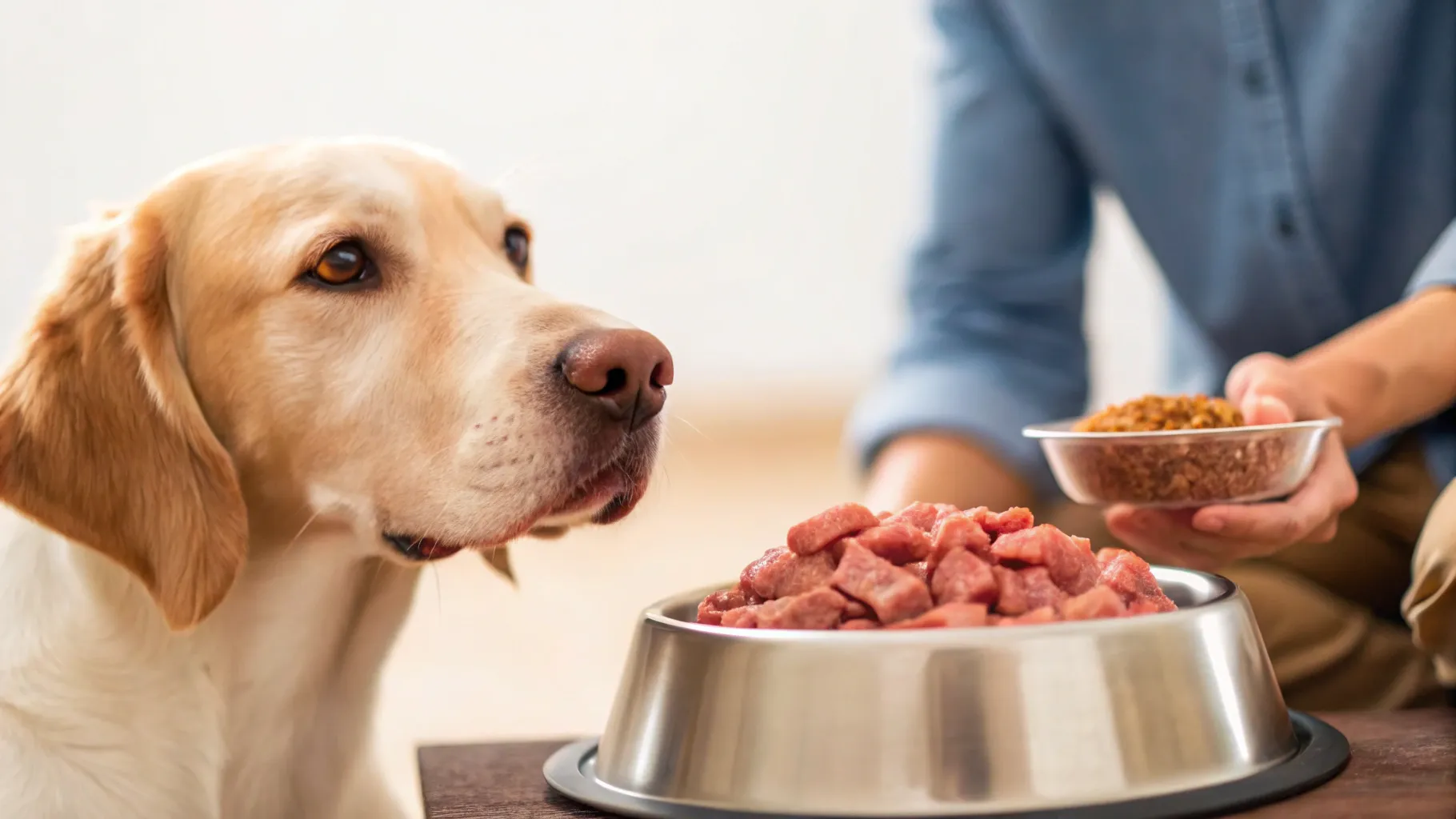
Phase 1: Initiate digestive priming at a 25% raw ratio. Feed 75% kibble and 25% raw, using a gentle protein like skinless turkey breast. This is a mandatory clinical step to introduce living enzymes without overwhelming the current microbiome. Don't panic if you see slight stool softening; it’s a normal sign the gut is shifting toward the higher acidity levels needed to process fresh food.
How Raw & Well automates this: The app calculates the exact gram-weight for this 25% introduction based on your dog's current caloric needs. This ensures you don't accidentally overfeed or underfeed during the foundational phase.
Step 2: Transition Phase (Days 4–7)
Phase 2: Reach the metabolic crossover threshold at 50%. Shift to a 50/50 ratio and introduce a tiny amount of liver (exactly 1%). This phase focuses strictly on biological stability. Watch for mild gas—it's a normal indicator of adaptation. Keeping ingredients consistent during this window is the most effective way to prevent systemic digestive confusion.
The Raw & Well clinical solution: Log your dog's stools in the app. If the "loose stool" alert triggers, our protocol automatically suggests a 48-hour pause at the current ratio to allow the gut to recalibrate before moving forward.
Step 3: Stabilization Phase (Days 8–10)
Phase 3: Reach 100% fresh-food autonomy. Scale to 75% raw on Day 8 and hit 100% by Day 10. Once the crossover is complete, begin full NRC 2006 nutrient balancing. This is the moment your dog begins absorbing 100% bioavailable nutrients, setting the stage for long-term clinical health.
How Raw & Well handles the math: Once you hit the 100% milestone, the app unlocks the full optimizer. It ensures all 35+ micronutrients meet Recommended Allowances instantly based on your dog's unique profile.
The IBD Recovery Protocol: Precision Staging
Step 1: Establish a Non-Reactive Baseline (Gut Calm Phase)
For IBD dogs, you must use a single novel protein like rabbit or venison, consisting of muscle meat only. You must avoid bone and organs initially. This serves as a required clinical step to "zero out" the immune system and identify if the primary protein is a biological trigger for inflammation.
The Raw & Well advantage: Our "Trigger Tracker" helps you log every reaction during Phase 1. This provides a clear visual record of when your dog achieves a 100% symptom-free state before you introduce more complexity.
Step 2: Build Nutrient Density via Micro-Introductions
Once stools are firm, introduce calcium via eggshells or calcium carbonate and begin scaling organs at a rate of 1% per week. This "slow-motion" introduction is specifically designed to rebuild nutrient stores without triggering a systemic flare in the damaged intestinal lining.
How Raw & Well streamlines this step: The app sets an "Organ Speed Limit" during IBD mode. Think of it as a governor for your dog's gut that prevents you from adding too much richness too fast, protecting the mucosal barrier.
Step 3: Reach Clinical NRC 2006 Stability
Gradually adjust all ingredients until you meet the full 35+ micronutrient targets while maintaining the symptom-free baseline you established. This data-backed approach to whole-food nutrition is the primary way to manage IBD long-term and support biological homeostasis.
How Raw & Well automates this: Our "Flare Forecast" monitors every ingredient shift. If a new addition correlates with stool changes, the app highlights the likely culprit and provides a safe revert-point for your meal plan.
People Also Ask About Raw Feeding and IBD in Dogs
Does L-glutamine supplementation help repair the IBD-damaged intestinal lining?
Yes. L-glutamine is the primary fuel for intestinal cells and is clinically essential for mucosal repair in IBD dogs. Supplementing 500mg per 10kg of body weight during recovery provides the building blocks for tight junction regeneration. Raw & Well integrates these targets into the IBD protocol alongside NRC 2006 protein requirements.
Can slippery elm be safely added to a raw diet for an IBD dog?
Yes, but timing is everything. Slippery elm coats the intestinal wall and reduces inflammatory signaling during flares. However, you must give it 30 minutes before or after meals, as it can slow the absorption of other nutrients. Raw & Well's IBD supplement guide includes exact timing instructions for each phase to ensure clinical accuracy.
How do I distinguish a normal raw transition reaction from an IBD flare?
Duration and character are the keys. A normal transition produces soft but formed stools that firm up within 5 to 7 days. An IBD flare produces liquid diarrhea, mucus, or blood that persists beyond 72 hours or gets progressively worse. Raw & Well's symptom journal generates a trend graph that makes this clinical distinction clear to both you and your vet.
Frequently Asked Questions
Which proteins are 'warm' vs 'cold' for IBD?
In clinical logic, novel proteins like Rabbit are considered 'cooling'. Many IBD dogs react better to cooling proteins (Rabbit, Whitefish) than 'warming' proteins (Chicken, Lamb) during a flare. Raw & Well helps you identify these properties to reduce intestinal heat and inflammation.
Should I use bone in an IBD transition?
No, you must start with muscle meat only. Whole bone is too mechanically abrasive for a damaged intestinal lining. Once the gut is calm (Phase 2), Raw & Well calculates the precise calcium carbonate or bone-dust amount needed to reach NRC 2006 targets without causing a relapse.
Can a raw diet cure IBD?
IBD is a condition you manage, not 'cure'. However, human-grade whole foods eliminate the artificial binders and carrageenan found in kibble—both known triggers for flares. By reaching NRC 2006 nutritional targets, you provide the building blocks your dog needs for long-term clinical remission.
Sources & References
- National Research Council. (2006). Nutrient Requirements of Dogs and Cats. Washington, DC: The National Academies Press. View Publication →
- PubMed / National Institutes of Health. (2023). Characterization of the canine fecal microbiome during transition. NCBI Reference →
- UC Davis Veterinary Medicine. (2024). Clinical Nutrition Services: Diet Transition Protocols. Institutional Guide →
- Raw & Well Clinical Registry. (2025). Novel protein response in canine IBD cases across varied breed types.