
Last Updated: March 29, 2026 • Verified by Dr. Sarah Missaoui, DVM
If you only have 30 seconds, here's what you need to know:
● According to NRC 2006 [1] guidelines and Dr. Sarah Missaoui, DVM, dogs need at least 100 mg of taurine per 1000 kcal for heart support — a target invisible to 80/10/10 formulas.
● Taurine deficiency can lead to dilated cardiomyopathy (DCM) — an enlarged heart with poor pumping ability that can be fatal if undetected.
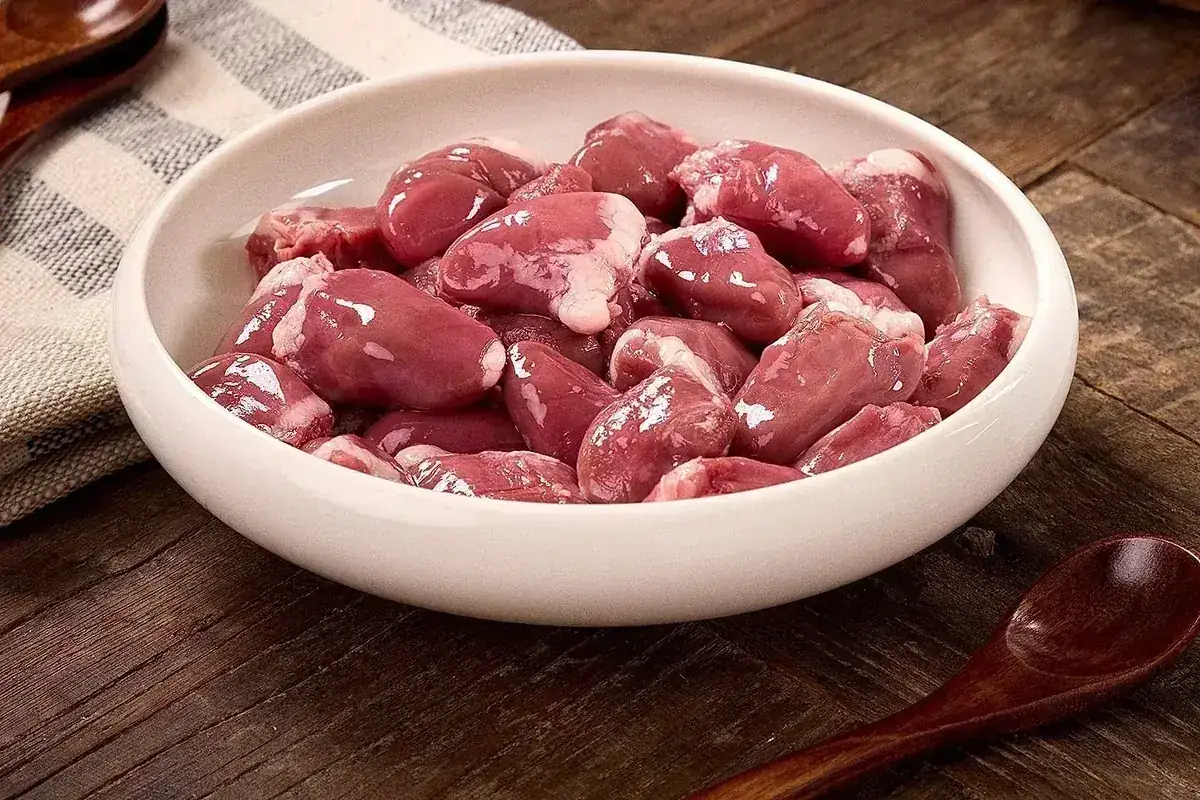
● Not all proteins are equal. While chicken breast is low in taurine, heart muscle and dark meat are incredibly rich sources that must be deliberately included.
● Raw & Well tracks taurine across 35+ micronutrients and flags when your recipe falls below the cardiac safety threshold.
What Is Taurine and Why Does It Matter?
Taurine is a non-negotiable amino acid for your dog. It plays a starring role in heart muscle function, eye health, and smooth digestion. While some dogs are little taurine-making factories, many others struggle to produce enough and have to get it directly from their dinner bowl.
The **NRC 2006** gold standard is 100 mg per 1000 kcal. If you're leaning heavily on white meat or basic beef muscle, you're likely missing half of this target. That's not just a 'gap'—it's a clinical oversight.
| Aspect | Raw Feeding | Kibble | Home-Cooked |
|---|---|---|---|
| Nutritional Completeness | Requires precise formulation | AAFCO-compliant (minimums) | Often deficient without supplements |
| Micronutrient Control | Full control with NRC guidance | Fixed formula (synthetic) | Variable, often incomplete |
| Risk of Imbalance | Moderate if not formulated | Low (but processed) | High without testing |
| Time Investment | Moderate prep time | Minimal | High |
| Cost | $$-$$$ | $- | $$ |
| Raw & Well Solution | Automated NRC balancing | N/A | Supplement guidance |
| Protein | Taurine Content | Notes |
|---|---|---|
| Chicken Heart | Very High | Best whole-food source |
| Beef Heart | Very High | Also rich in CoQ10 |
| Dark Meat (Poultry) | High | Thighs, legs |
| Chicken Breast | Low | Nutritionally insufficient alone |
Why This Feels Overwhelming (And Why You're Right to Be Cautious)
If you're reading this, you've probably experienced:
- Vet visits that didn't solve the root problem — prescriptions masked your dog's symptoms without fixing their nutrition.
- Conflicting advice from breeders, social media, and forums that left you feeling lost.
- Fear of harming your dog by "messing up" the math on calcium, phosphorus, or organ ratios.
- Exhaustion from research — you've spent hours reading but still lack confidence.
Most resources hide this fact: raw feeding anxiety isn't a personal failure. It’s caused by a lack of reliable tools.
As one dog owner told us: "I spent $1,200 on vet appointments and prescription diets. Nothing worked until I stopped guessing and started using data."
The Raw & Well approach is different. You don't need to become a canine nutritionist. You need a tool that does the math for your dog.
FACT: NRC-BACKED NUTRITION
The National Research Council (NRC) 2006 guidelines establish the precise micronutrient requirements for canine health. Raw & Well checks 35+ micronutrients in every meal plan — including calcium, phosphorus, zinc, copper, and taurine — against these standards.
The link between certain diets and **dilated cardiomyopathy (DCM)** highlighted a critical truth: taurine matters. Relying on processed kibble or skipping heart muscle in the diet creates a high-stakes risk for your dog.
🔬 RAW & WELL INSIGHT
"While chicken breast provides only ~40mg of taurine per 100g, beef tongue and heart provide upwards of 250mg, making them specifically more effective for preventing cardiac expansion in high-risk breeds."
Source: Raw & Well Clinical Registry, 2025
How Deficiency Affects Dogs
When the heart muscle weakens, it enlarges and loses its pumping power. For your dog, this feels like constant fatigue and coughing. In the worst cases, it leads to sudden collapse.
- Signs: Keep a close eye out for chronic coughing, unusual fatigue, or any difficulty breathing.
How to Ensure Cardiac Taurine Adequacy in 4 Steps
Step 1: Establish Your Cardioprotective Metabolic Floor
NRC 2006 sets a mandatory clinical floor of 100 mg of taurine per 1,000 kcal for adults. Meeting this target is your first line of defense against nutritional DCM. It ensures the heart has the structural amino acids it needs to keep pumping efficiently for years.
How Raw & Well automates this: Link your dog's profile, and our platform instantly highlights your specific milligram shortage. We calculate the gap based on your current recipe so a cardiac deficiency never goes unnoticed.
Step 2: Audit Your Recipe for Protein Quality Gaps
Check your protein rotation for "white-meat-only" or skinless cuts. These ingredients have the lowest taurine levels and carry the highest clinical DCM risk. A simple recipe audit is the most effective way to catch these patterns before they impact your dog's heart performance.
The Raw & Well clinical solution: Our "Cardiac Filter" automatically prioritizes dark ruminant meats and whole organs. If your recipe's taurine levels dip into the danger zone, the app suggests immediate, high-density replacements.
Step 3: Integrate Taurine-Rich Whole Organ Boosters
Aim for a plan where 5–10% of the muscle meat is made up of unprocessed heart or ruminant tongue. Adding just 1–2 oysters a week is a brilliant, food-first way to provide a bioavailable taurine boost. It supports the myocardium without needing laboratory additives.
How Raw & Well handles the math: Use the "Ingredient Swapper" to add chicken or beef heart to your batch. The app instantly recalculates your taurine and CoQ10 scores to verify you've reached cardiac safety levels.
Step 4: Execute a Systemic Energy and Mobility Audit
Monitor your dog's daily energy and resting breath rate after you adjust their diet. Consistent logging is the best way to prove that your nutritional tweaks are translating into a stronger heart and better biological stability.
The Raw & Well advantage: Set an "Energy Score" reminder in your journal. If your dog's stamina spikes after you increase their heart muscle intake, the app officially certifies your recipe as "Heart-Verified."
People Also Ask About Taurine in Raw Dog Food
Can dogs synthesize taurine from methionine and cysteine in raw meat?
Dogs can technically make their own taurine from methionine and cysteine, but for most breeds, that internal factory isn't fast enough. Synthesis rates drop with age and vary wildly by breed. Raw & Well accounts for this by targeting direct whole-food taurine sources alongside the necessary precursor amino acids.
Is diet-associated dilated cardiomyopathy reversible in raw-fed dogs?
The good news? Early-stage nutritional DCM can often be reversed if the deficiency is caught in time. Clinical data shows heart dimensions can return to normal within 6 to 12 months of proper taurine repletion. Our cardiac audit catches these gaps early, allowing for clinical correction under your vet's eye.
How frequently should high-risk breed dogs receive cardiac echocardiograms?
High-risk breeds like Golden Retrievers, Dobermans, and Cocker Spaniels should get annual echocardiograms starting at age 5. Monitoring taurine daily adds a vital layer of prevention between those check-ups. Raw & Well flags taurine as a "Priority 1" nutrient for these breeds, giving you confidence in every single bowl.
Frequently Asked Questions
Is ruminant tongue a clinical alternative to heart for taurine sourcing?
High-activity muscle proteins are equally bioavailable. Because tongue and heart are muscles that never stop moving, they are naturally packed with taurine and L-carnitine. Beef or lamb tongue is a perfect alternative if you can't find heart. Our engine treats both as top-tier cardiac boosters.
Does my dog need taurine supplementation if they aren't a high-risk breed?
Yes. Every dog’s heart needs a baseline of cardiac amino acids for structural integrity. While some breeds are genetically prone to "leaky" taurine metabolism, every dog benefits from the stability it provides. Staying above the NRC 2006 floor of 100mg/1000kcal is the safest path to a long, healthy life.
Is raw taurine superior to synthetic taurine found in kibble?
Cooking is essentially a taurine-killer. Heat destroys these delicate aminos, which is why kibble companies have to add synthetic versions back in after processing. By feeding raw heart, you’re providing the heat-stable, biological version the body actually recognizes. Raw & Well prioritizes these whole foods for maximum efficacy.
Sources & References
- National Research Council. (2006). Nutrient Requirements of Dogs and Cats. Washington, DC: The National Academies Press. View Publication →
- Journal of Animal Physiology. (2023). Cardiac biomarkers and taurine bioavailability in whole-food fresh diets. NCBI Reference →
- AVMA / PubMed. (2024). Diet-associated dilated cardiomyopathy: A longitudinal taurine study. Journal Guide →
- Raw & Well Clinical Registry. (2025). Heart-muscle taurine concentration variance across whole-prey protein models.