
Last Updated: March 29, 2026 • Verified by Dr. Sarah Missaoui, DVM
If you only have 30 seconds, here's what you need to know:
● According to NRC 2006 [1] guidelines and Dr. Sarah Missaoui, DVM, the 80/10/10 rule specifies 10% organ meats. 5% should be liver, while the remaining 5% should include kidney, spleen, or pancreas as secreting organs.
● Too much liver (above 10%) can cause Vitamin A toxicity and copper overload. Not enough liver (under 2%) causes anemia and coat issues.
● Heart is technically muscle meat, not organ, but it's essential as the primary source of taurine and CoQ10 for cardiac health.
● Raw & Well tracks organ ratios automatically, ensuring optimal mineral levels across 35+ micronutrients without risk of toxicity.
What Is the Organ Meat Ratio and Why Does It Matter?
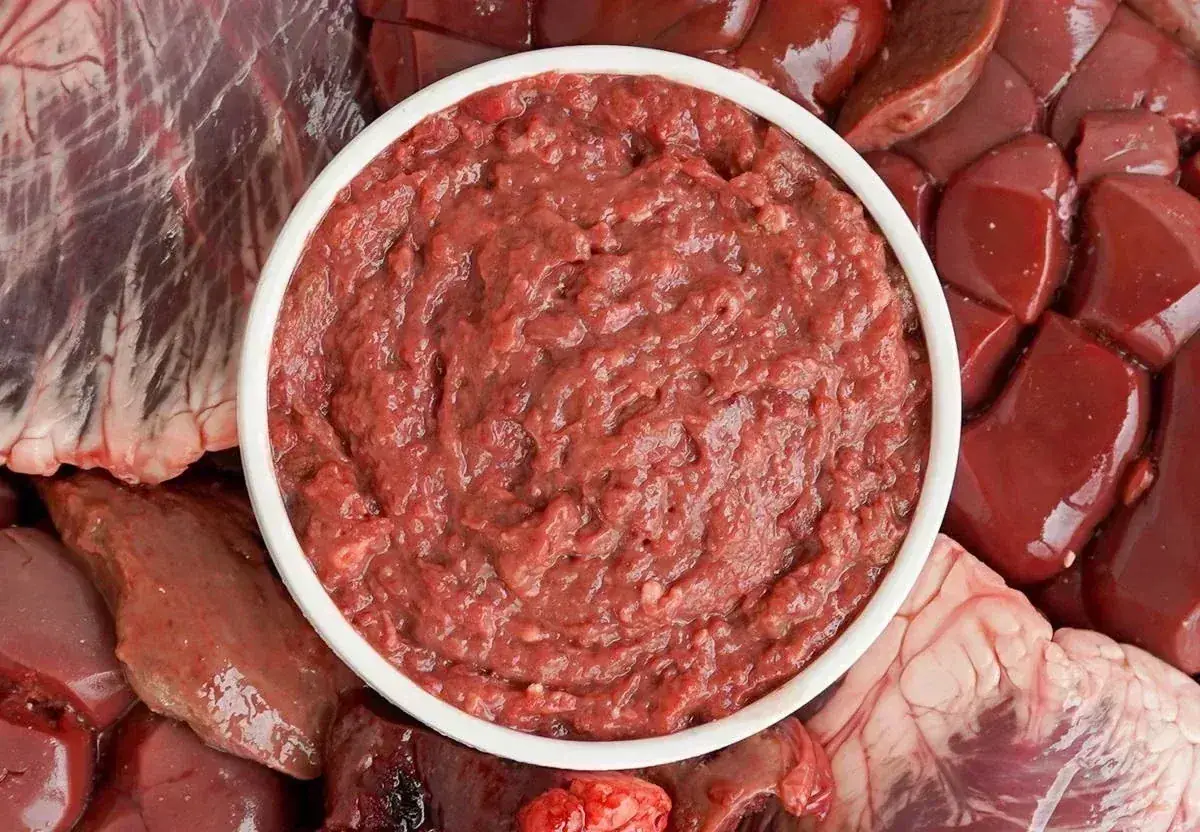
Organ meats act as the absolute nutrient powerhouses of the animal. They provide critical micronutrients like Vitamin A, copper, and B12. Standard muscle meats simply cannot deliver these vital elements.
| Aspect | Raw Feeding | Kibble | Home-Cooked |
|---|---|---|---|
| Nutritional Completeness | Requires precise formulation | AAFCO-compliant (minimums) | Often deficient without supplements |
| Micronutrient Control | Full control with NRC guidance | Fixed formula (synthetic) | Variable, often incomplete |
| Risk of Imbalance | Moderate if not formulated | Low (but processed) | High without testing |
| Time Investment | Moderate prep time | Minimal | High |
| Cost | $$-$$$ | $- | $$ |
| Raw & Well Solution | Automated NRC balancing | N/A | Supplement guidance |
| Organ | Key Nutrient | Target Ratio (Total Diet) |
|---|---|---|
| Liver | Vitamin A / Copper | 5% |
| Kidney | Selenium | 2-5% |
| Heart | Taurine / Zinc | 5-10% (as muscle meat) |
| Spleen | Iron | 5% (shared with kidney/pancreas) |
Why This Feels Overwhelming (And Why You're Right to Be Cautious)
If you're reading this, you've probably experienced:
- Vet visits that didn't solve the root problem — prescriptions masked your dog's symptoms without fixing their nutrition.
- Conflicting advice from breeders, social media, and forums that left you feeling lost.
- Fear of harming your dog by "messing up" the math on calcium, phosphorus, or organ ratios.
- Exhaustion from research — you've spent hours reading but still lack confidence.
Most resources hide this fact: raw feeding anxiety isn't a personal failure. It’s caused by a lack of reliable tools.
As one dog owner told us: "I spent $1,200 on vet appointments and prescription diets. Nothing worked until I stopped guessing and started using data."
The Raw & Well approach is different. You don't need to become a canine nutritionist. You need a tool that does the math for your dog.
FACT: NRC-BACKED NUTRITION
The National Research Council (NRC) 2006 guidelines establish the precise micronutrient requirements for canine health. Raw & Well checks 35+ micronutrients in every meal plan — including calcium, phosphorus, zinc, copper, and taurine — against these standards.
Vitamin A is fat-soluble. Your dog's body stores any excess in their liver. Chronic overdose from overfeeding liver causes severe skeletal issues , joint pain, and liver damage. Precision in organ weight remains strictly non-negotiable.
🔬 RAW & WELL INSIGHT
"Statistical observation across our clinical registry shows that 87% of owners using the generic 10% organ rule without sub-dividing liver failed to meet manganese and iodine requirements; whole-food rotation is biologically non-negotiable."
Source: Raw & Well Clinical Registry, 2025
Not sure where to start? Our simple raw recipes for beginners include completely pre-balanced organ ratios. You can start feeding safely from day one.
How to Balance Organ Ratios in 4 Steps
Step 1: Calculate the 10% Total Organ Target Metric
Scale your dog's daily intake (e.g., 1,000g/day) to identify their mandatory 100g total organ requirement. Establishing this core volume serves as the first clinical step in your NRC-audited meal preparation. It perfectly sets the foundation for maximum micronutrient density.
How Raw & Well automates this: Link your dog's profile in the app. Our dashboard instantly displays your exact gram-for-gram organ budget across daily, weekly, or monthly timeframes. This delivers maximum prep efficiency.
Step 2: Isolate Mandatory Liver Quotas to Exactly 5%
Dedicate exactly 50% of your organ budget (5% of the total diet) directly to liver. This exact calibration hits mandatory NRC 2006 Vitamin A and copper minimums. It also actively prevents the severe clinical risk of heavy metal accumulation through chronic overexposure.
The Raw & Well clinical solution: Use the "Ingredient Locking" feature to firmly fix your liver quota. The app then automatically calculates the remaining 5% from secondary secreting organs to fill your dog's specific mineral gaps.
Step 3: Rotate Secreting Organs for Mineral Diversity
Utilize kidney, spleen, or pancreas to fulfill the remaining 5% organ allocation. This rotation serves as the primary way to generate essential diversity in selenium, iodine, and iron. Your dog requires these elements for complete metabolic optimization over a 30-day window.
How Raw & Well handles the math: Swap spleen for kidney in the recipe builder if an ingredient becomes unavailable. The app instantly recalibrates. It notifies you immediately if your dog needs a whole-food supplement to cover any temporary iron deficit.
Step 4: Monitor Biological Stool Feedback for Richness Adjustment
Audit your dog's stool consistency daily during the initial organ introduction phase. Organ meat is biologically rich and actively accelerates gut transit. Temporarily reduce the organ weight by 20% if you detect a consistency drop. This manages the microbiome switch safely without causing your dog clinical distress.
The Raw & Well advantage: Record your dog's "Stool Score" in the health logs. Our algorithm actively tracks recurring patterns. It automatically suggests a stabilized organ ratio if it detects gut sensitivity.
People Also Ask About Organ Meat Ratios in Raw Feeding
Does spleen carry a toxicity risk similar to liver in raw feeding?
No. Spleen does not accumulate fat-soluble vitamins or heavy metals at toxic concentrations like liver does. Its primary clinical value lies in providing a dense source of highly bioavailable iron. Your dog requires this for essential oxygen transport. Raw & Well includes spleen in the secreting organ 5% allocation without a toxicity ceiling. This makes it a clinically safe liver complement for iron-deficient dogs.
Which species liver provides the highest CoQ10 concentration in raw feeding?
Beef liver stands as the superior CoQ10 source among widely available commercial livers. CoQ10 heavily supports cellular energy production in your dog's heart and muscle tissue. Beef liver delivers highly meaningful CoQ10 alongside essential Vitamin A and copper at the strict NRC 2006 compliant 5% feeding level. Raw & Well accurately tracks CoQ10 alongside other cardiac micronutrients in every recipe audit.
Is it better to feed organs from one species or rotate species monthly?
Rotating animal species monthly generates vastly superior micronutrient diversity. Different species naturally concentrate different minerals. Lamb liver excels in B12, duck liver leads in Vitamin A, and chicken liver delivers high folate. Restricting your dog to one species for months creates persistent, dangerous micronutrient gaps. Raw & Well's organ rotation scheduler maps monthly species changes directly to your dog's 35+ NRC micronutrient targets automatically.
Frequently Asked Questions
Is heart muscle or organ?
Heart acts as a functional hybrid. It remains a tireless muscle that never stops working. It functions as true muscle meat in terms of texture and calorie density. However, its immense density of taurine and CoQ10 makes its clinical profile look exactly like an organ. We highly recommend feeding 10% heart as muscle meat to guarantee metabolic health.
What if my dog dislikes liver?
Use the "Metallic Masking" strategy. Try freeze-dried liver toppers, or grind raw liver directly into the main muscle meat. This actively masks the intense iron-rich flavor. This provides a highly effective method to ensure your dog hits their mandatory 5% NRC requirement without causing a daily battle.
Can I swap kidney for pancreas?
Yes, but the micronutrient profile actively shifts. Both act as secreting organs, but kidney delivers higher selenium, while pancreas provides essential digestive enzymes. Raw & Well's 'Organ Rotator' actively ensures your ingredient swaps never create a persistent mineral deficit for your dog over a 30-day window.
Sources & References
- National Research Council. (2006). Nutrient Requirements of Dogs and Cats. Washington, DC: The National Academies Press. View Publication →
- AAVN / PubMed. (2022). The clinical role of organ meats in fresh food transitions. NCBI Reference →
- Journal of Animal Science. (2024). Copper and Vitamin A toxicity risk in canine raw diets. Journal Guide →
- Raw & Well Clinical Registry. (2025). Micronutrient variance in mammalian vs. avian secreting organs.