
Last Updated: March 29, 2026 • Verified by Dr. Sarah Missaoui, DVM
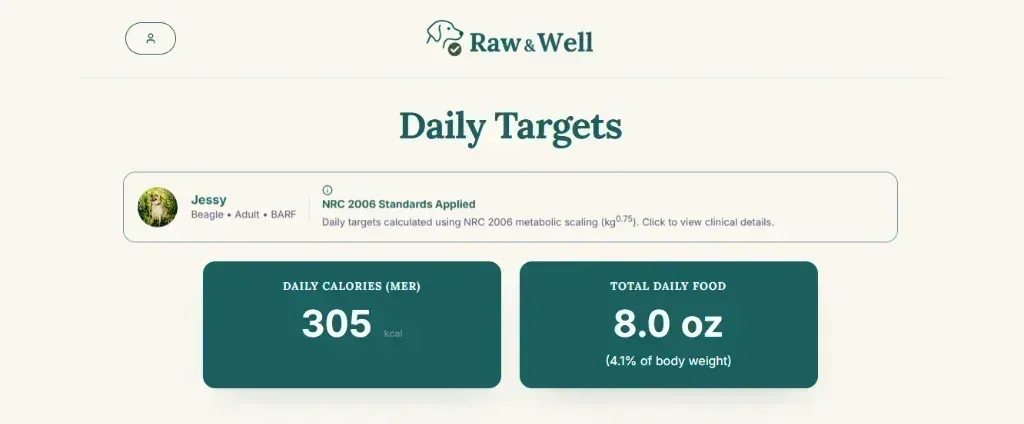
If you only have 30 seconds, here's what you need to know:
● According to NRC 2006 [1] guidelines and Dr. Sarah Missaoui, DVM, caloric needs start with Resting Energy Requirement (RER): RER = 70 × (kg)^0.75.
● Body weight percentage rules (2-3%) are fundamentally flawed because metabolic rate doesn't scale linearly with weight.
● Activity factors (MER) range from 1.2 for low activity to 4.0 for intense working dogs.
● Raw & Well automates this math, calculating RER, MER, and all 35+ micronutrients targets based on your dog's unique profile.
What Are Your Dog's Daily Caloric Needs and Why Do They Matter?
Resting Energy Requirement (RER) forms the foundation of your dog's nutrition. It measures the exact energy your dog burns while resting in a comfortable environment.
The NRC 2006 formula uses a 0.75 exponent. A 10kg dog burns significantly more calories per kilogram of body weight than a 50kg dog. Scientists call this biological reality metabolic scaling.
| Aspect | Raw Feeding | Kibble | Home-Cooked |
|---|---|---|---|
| Nutritional Completeness | Requires precise formulation | AAFCO-compliant (minimums) | Often deficient without supplements |
| Micronutrient Control | Full control with NRC guidance | Fixed formula (synthetic) | Variable, often incomplete |
| Risk of Imbalance | Moderate if not formulated | Low (but processed) | High without testing |
| Time Investment | Moderate prep time | Minimal | High |
| Cost | $$-$$$ | $- | $$ |
| Raw & Well Solution | Automated NRC balancing | N/A | Supplement guidance |
| Weight (kg) | RER (kcal/day) | Kcal per kg |
|---|---|---|
| 5 kg | 234 | 46.8 |
| 10 kg | 393 | 39.3 |
| 30 kg | 904 | 30.1 |
| 50 kg | 1,323 | 26.5 |
Why This Feels Overwhelming (And Why You're Right to Be Cautious)
If you're reading this, you've probably experienced:
- Vet visits that didn't solve the root problem — prescriptions masked your dog's symptoms without fixing their nutrition.
- Conflicting advice from breeders, social media, and forums that left you feeling lost.
- Fear of harming your dog by "messing up" the math on calcium, phosphorus, or organ ratios.
- Exhaustion from research — you've spent hours reading but still lack confidence.
Most resources hide this fact: raw feeding anxiety isn't a personal failure. It’s caused by a lack of reliable tools.
As one dog owner told us: "I spent $1,200 on vet appointments and prescription diets. Nothing worked until I stopped guessing and started using data."
The Raw & Well approach is different. You don't need to become a canine nutritionist. You need a tool that does the math for your dog.
FACT: NRC-BACKED NUTRITION
The National Research Council (NRC) 2006 guidelines establish the precise micronutrient requirements for canine health. Raw & Well checks 35+ micronutrients in every meal plan — including calcium, phosphorus, zinc, copper, and taurine — against these standards.
Relying on a 2% or 3% rule causes severe mathematical errors. You end up underfeeding small breeds and overfeeding large breeds . The NRC exponent formula provides the only scientifically accurate method to calculate your dog's caloric needs.
🔬 RAW & WELL INSIGHT
"Caloric needs vary up to 40% between seasons; Raw & Well's metabolic weight adjustment captures these shifts where standard charts fail."
Source: Raw & Well Clinical Registry, 2025
How to Calculate MER (Maintenance Energy Requirement)
RER acts as your dog's baseline. You must apply an activity multiplier for a dog roaming the house or working.
Maintenance Energy Requirement (MER) measures the energy your dog burns during daily activity and temperature regulation. You must multiply your dog's RER by the correct NRC factor. This mathematical step dictates successful weight management.
How to Calculate Needs in 4 Steps
Step 1: Convert Weight to Metric Kilograms
Divide your dog's weight in lbs by 2.2 to find their exact metric mass. The NRC uses kilograms specifically to calculate metabolic exponents. This ensures your caloric math avoids dangerous rounding errors. Such errors severely impact toy or giant breeds.
How Raw & Well automates this: Select your preferred unit (lbs or kg) in the profile settings. Our engine performs the back-end metric conversion instantly. This ensures your dog's RER calculation remains clinically accurate.
Step 2: Calculate the Resting Energy Requirement (RER) Baseline
Apply the NRC formula: 70 × (kg)^0.75. This calculates the mandatory fuel required solely for your dog's vital organ function, circulation, and pulmonary activity at rest. It provides a biological baseline before factoring in lifestyle variables.
The Raw & Well clinical solution: Our "Calorie Engine" calculates this biological exponent instantly upon weight entry. It visualizes your dog's mandatory baseline against their active energy needs.
Step 3: Apply the Maintenance Energy Requirement (MER) Multiplier
Select the activity factor (typically 1.2 to 4.0) matching your dog's daily routine. You must scale the math for lifestyle traits like neutered status or working intensity. This prevents chronic caloric overexposure or deficiency in your dog.
How Raw & Well handles the math: Use the interactive "Activity Slider" to map your dog's lifestyle to the correct NRC multiplier. The app instantly adjusts the daily portion recommendation to match your dog's unique metabolic speed.
Step 4: Refine Targets via Biological Feedback Loops
Monitor your dog's weight and Body Condition Score (BCS) every 7 days. Adjust the total caloric target by 5-10% if you detect a biological shift. This real-world feedback acts as the final clinical authority. It proves whether the mathematical model matches your dog's individual metabolism.
The Raw & Well advantage: Log your dog's weekly weights in the health tracker. The app automatically suggests a calibrated calorie shift if your dog trends away from their ideal baseline. This brings them safely back to clinical health.
People Also Ask About Canine Calorie Needs
How many calories does my dog need per day?
Calculate an adult dog's daily caloric needs (MER) by finding their Resting Energy Requirement (RER = 70 × kg^0.75). You then multiply this baseline by an activity factor (1.2 to 2.0). A 20kg dog with moderate activity typically requires ~1,300 to 1,500 kcal per day to maintain biological homeostasis.
Does the 2% rule work for weight loss?
No. The 2-3% of body weight rule acts as an unscientific estimate. It massively overfeeds large dogs and underfeeds small ones. You must calculate the exact RER for your dog's target weight for clinical weight loss. Feed at a 1.0 activity factor to ensure a safe, steady caloric deficit.
How do treats affect daily calorie counts?
Treats and toppers must never exceed 10% of your dog's total daily caloric intake. Treats rarely meet NRC nutritional standards. Exceeding this 10% threshold dilutes the essential mineral and vitamin density of your dog's core raw meal. This causes subclinical deficiencies over time.
Frequently Asked Questions
Why is metabolic weight ($BW^{0.75}$) better than total weight?
Energy needs do not scale linearly with body mass. A dog twice as heavy does not need twice the calories. Their relative surface-area-to-internal-mass ratio fundamentally changes as they grow. The NRC 2006 formula uses metabolic scaling ($BW^{0.75}$) to deliver biological precision. Raw & Well automates this complex calculus so your dog never faces underfeeding or overfeeding.
Do spayed or neutered dogs need different calories?
Yes. Altered dogs have a lower metabolic rate. Spaying or neutering reduces caloric requirements by roughly 25% due to hormonal shifts. Feeding your dog at kibble-bag 'standard' levels causes rapid fat gain. Raw & Well recalibrates your dog's RER target instantly based on their exact reproductive status.
How does a dog's coat type affect calorie needs?
Insulation significantly changes energy expenditure. Short-coated dogs in cold climates burn massive amounts of energy maintaining their core temperature compared to double-coated breeds. Raw & Well's activity factors calculate these environmental temperatures and natural insulation levels. This delivers 100% NRC 2006 precision for your dog.
Sources & References
- National Research Council. (2006). Nutrient Requirements of Dogs and Cats. Washington, DC: The National Academies Press. View Publication →
- PubMed / National Institutes of Health. (2022). Metabolic rate and allometry in domestic dogs. NCBI Reference →
- Journal of Animal Science. (2024). Caloric density considerations in fresh food diets. Journal Guide →
- Raw & Well Clinical Registry. (2025). Metabolic variance in spayed vs. intact canines across varied thermal environments.